

How to Find Your Target Audience
Knowing who you’re talking to is the first step to building any meaningful relationship, especially in marketing.
Understanding your target audience helps you create campaigns that connect, content that resonates and strategies that convert. Whether you're launching a product, running ads or refining your brand voice, it all begins with one crucial question:
Who are you trying to reach?
At HAVEN, we help brands answer that question with confidence, clarity and creativity. So let’s explore what a target audience is and how you can take advantage of it.
What is a Target Audience?
Your target audience is the group of people most likely to care about what you're selling. These are your people. Your brand's biggest fans, even if they just don't know it yet.
They share things in common—like interests, challenges, values or even zip codes—that make them more likely to click, buy, subscribe or tell their friends.
Identifying your target audience isn’t about exclusion. It’s about precision. When you know who you're speaking to, your brand positioning and messaging will feel tailored, and that’s what drives action.
Why Knowing Your Target Audience is Important
If you’re not talking to the right people, even the best marketing won’t move the needle. Here’s why defining your audience is a game-changer:
- Increased ROI: Your budget goes further when your message lands with people who are already interested.
- Smarter creative decisions: From copy to design, your assets will reflect what your audience actually wants.
- Stronger brand loyalty: When people feel seen and understood, they stick around.
- More effective content: Personalization improves open rates, click-throughs, and engagement across all platforms.
In short, the better you know your audience, the better your results.
Types of Target Audiences
Your audience isn’t just a crowd of clones. They're made up of different layers, and slicing them the right way helps you market smarter. Here’s how you can group them:
- Demographic: Age, gender, income, education level, marital status
- Psychographic: Interests, values, personality traits, lifestyle choices
- Behavioral: Buying habits, product usage, brand loyalty, decision-making process
- Geographic: Country, region, city, climate, urban vs. rural
Your audience often consists of a mix of these types. The key is to combine them to give you the clearest picture of your ideal customer.
How to Define Your Target Audience
Creating a detailed profile of your target audience doesn’t happen overnight, but it pays off long term. Here’s how to get started:
Conduct Market Research
Start by understanding the landscape in which your business operates. Market research helps you grasp industry trends, consumer behaviors, and who your competitors are targeting. Use a mix of primary research (like interviews and focus groups) and secondary research (like industry reports and competitor analysis) to build a comprehensive foundation.
Analyze Customer Data
If you already have customers, use your internal data to identify patterns. Look at who is buying from you, what they’re buying, how often, and through what channels. Analyze CRM data, website analytics, sales reports and customer service logs. These insights help reveal which types of people are naturally drawn to which offering.
Use Surveys and Feedback Tools
Quantitative data tells you what people are doing. Surveys and feedback tools help you understand why they’re doing it. Ask questions about customer motivations, decision-making criteria, preferences and frustrations, and combine this with analytics tools to get a fuller picture of your audience’s behavior across platforms.
Identify Pain Points and Goals
Go beyond demographics. The most effective audience definitions are rooted in what customers need, what drives their behavior and what’s standing in their way. Are they seeking speed, simplicity, affordability or expertise? What objections might they have? Understanding these elements allows you to shape messaging that resonates and removes barriers to engagement.
Refine Over Time
Defining your audience isn’t a one-and-done checklist item. It’s an ongoing process. As your business grows, your data set expands. Revisit your audience definitions regularly, especially after new campaigns or product launches. Use performance metrics to test assumptions, uncover new segments and adapt to shifts in customer behavior.
Target Audience Segmentation and Customer Personas
Here’s the secret sauce: once you’ve identified your broader audience, break them into smaller, smarter segments. Not every customer is the same, even if they look the same on paper.
By grouping people based on things like age, behavior or buying stage, you can create customer personas—realistic profiles that help you market more intentionally.
- Age-based segmentation lets you customize tone and design
- Interest-based segmentation helps guide your content calendar
- Behavior-based segmentation allows for precision targeting in remarketing campaigns
These segments can then be translated into detailed customer personas—fictional representations of your ideal customers based on real data. When you create messaging for a persona, you're speaking directly to a human, not a spreadsheet.
Find Your Target Audience with HAVEN
The secret to great marketing isn’t just knowing what to say—it’s knowing who you’re saying it to. That’s where we come in.
At HAVEN, we specialize in getting crystal clear on your ideal audience. Whether you're in automotive aftermarket, industrial manufacturing, or heavy equipment, we know your people, how they think, what drives them and where to reach them.
Our process starts with a deep-dive strategy session, where we sit down with your key stakeholders to discuss business goals, audience insights and market positioning. It’s not a surface-level brainstorm—it’s a working session designed to build the foundation for a strategy that actually performs.
You bring the subject matter expertise, and we’ll bring the audience clarity. Schedule your strategy session today, and let’s map out your next move.

How to Create a Customer Persona
You wouldn’t throw a party without knowing who’s coming, right? The same goes for marketing.
If you’re trying to reach your ideal customer without a clear picture of who they are, you’re basically yelling into a crowd, waiting for someone to turn around.
That’s where customer personas come in.
In this guide, we’ll walk you through what a customer persona is, why it matters and how to build one that actually helps you connect with the people who matter most to your business.
What is a Customer Persona?
A customer persona is a detailed snapshot of your ideal customer. It’s not just a guess—it’s based on real data, real behavior and a few educated assumptions.
At its core, a persona helps you understand:
- Who your audience is
- What they care about
- What problems they’re trying to solve
- How they make decisions
It’s not just about demographics—it’s about getting inside your customer’s head so you can speak directly to their needs, goals and quirks.
Why Are Customer Personas Important?
Let’s be honest: generic marketing doesn’t work anymore. People want brands to understand them, not to bombard them with noise.
When you take time to build accurate personas, you can:
- Create messaging that actually resonates
- Tailor your offers to real problems
- Show up in the right place, at the right time
In short, you’ll stop wasting time (and money) on campaigns that miss the mark.
The Benefits of Buyer Personas
Personas aren’t just a marketing trend—they’re a cornerstone of modern marketing. When you truly understand who your audience is, every move becomes more strategic, more intentional, and ultimately more successful. Here’s what that looks like in action:
Improved Targeting and Content Creation
When you know what your ideal customer cares about, you can craft content that speaks to them directly. Instead of casting a wide net and hoping something lands, you’ll create strategic communications, blog posts, ads and emails that feel like they were made just for them.
Personalization of Marketing Messages
Personalization goes way beyond adding someone’s name to an email. A well-built persona helps you align your messaging with your audience’s mindset, pain points and aspirations.
Better Lead Qualification and Prioritization
Not every lead is worth the same investment. Personas help you identify which leads are more likely to convert and which ones may need more nurturing, or can be skipped altogether.
Enhanced Customer Experience and Satisfaction
When customers feel like your brand “gets” them, trust builds quickly. Personas help you anticipate what people need at each stage of their journey, whether it’s educational content during research or timely support post-purchase.
More Informed Decision-Making
From product development to ad spend allocation, personas give you context to make smarter choices. Instead of relying on gut instinct, you can point back to real insights about your ideal customer. The result? Better strategies and fewer costly missteps.
How to Create a Customer Persona
Ready to start building customer personas that actually work? Here's a practical breakdown of how to go from raw data to refined strategy:
Conduct Research
Start with your current customers. Reach out with surveys, schedule interviews, and dig into support conversations and reviews. Ask open-ended questions like:
- What made you choose our brand?
- What challenges were you facing before you found us?
- What hesitations did you have?
This qualitative data will give you a real feel for your audience’s needs, values and decision-making process.
Use Analytics
Your digital footprint holds many clues. Analyze your website traffic to see which pages are visited most, which CTAs get clicked and where people drop off. Look at email open and click rates, product views and cart abandonment data. This will help you understand what your audience actually does, not just what they say.
Leverage Social Media
Don’t just post—observe. Which posts are getting likes, saves and shares? What questions are people asking in the comments? How are they interacting with similar brands? Social platforms offer a real-time window into your audience’s interests, language and pain points.
Use a Template
Once you have your data, structure it. A good persona template includes fields like:
- Name, age and job title
- Goals and pain points
- Common objections
- Preferred communication channels
- Buying behavior
You don’t need a dozen personas—just a few well-crafted ones that represent your core segments can go a long way.
Target Audience Segmentation and Customer Personas
Before you create customer personas, you need to know how your audience breaks down. Segmentation is the process of grouping people based on things like:
- Age
- Location
- Interests
- Behavior
This gives your personas more clarity and your messaging more precision. Want a deeper dive? Check out our post on unlocking the power of audience personas.
Find Your Customer Persona with HAVEN
You Know Your Subject Matter. We Know Your Customers. Great marketing happens when those two things meet in the middle—and that’s exactly what we do at HAVEN.
Our personas aren’t fluff-filled guesswork. They’re grounded in deep, niche-specific research across the industries we know best, such as automotive aftermarket, industrial manufacturing, and heavy equipment. We understand who your buyers are, what drives their decisions and how to move them from interest to action.
When we build personas, we’re not just creating avatars—we’re unlocking marketing clarity—the kind that leads to stronger messaging, better targeting and higher ROI.
Ready to map out your customer personas with a team that already speaks your audience’s language? Schedule a free consultation with us.

Mastering Off-Road Marketing: Best Practices for Engaging Adventure Enthusiasts
Marketing off-road gear isn't just about selling products—it's about tapping into the spirit of adventure, the thrill of the unknown, and the drive to conquer new terrain. Off-road enthusiasts aren’t your typical customers. They’re a dedicated tribe, constantly seeking the best gear to fuel their off-road journeys.
To connect with this passionate group, you need a marketing approach that speaks directly to their adventurous souls. Let's dive into how to master off-road marketing and build lasting connections with vehicle owners who live for the next adventure.
Why Off-Road Enthusiasts Are a Unique Audience
Off-road enthusiasts aren’t just vehicle owners—they’re explorers, thrill-seekers, and often, rugged individualists who thrive on overcoming challenges.
They rely on their vehicles not only to get them from point A to point B but to unlock experiences and opportunities that most can’t even imagine.
Whether they’re blazing trails through mountain ranges, crawling over rocky hills, or tackling muddy swamps, they need gear that’s tough, reliable, and able to withstand the elements.
These are the customers who live and breathe off-roading. And when it comes to their gear, they don’t compromise. Quality is paramount. It’s not just about durability; it’s about the ability to perform in extreme conditions. If you can speak to their need for adventure and show how your products enhance their off-road experience, you’ll build a connection that lasts.
The Role of Authentic Branding in Engaging Off-Road Enthusiasts
Authenticity is the secret sauce when it comes to connecting with off-road enthusiasts. This audience is as discerning as they come, and they can tell when a brand is trying too hard or faking it. To truly resonate, your brand positioning must reflect their lifestyle, not just the product you’re selling.
Take it from one of our clients in the off-road industry: Fab Fours. They came to us looking to tighten their email marketing game—and we delivered a full strategic overhaul. By building out a clean, consistent template, we helped them highlight their bold, boundary-pushing brand in a way that felt authentic and visually striking.
The result? A smarter, automated email strategy that not only looked better but drove better engagement with their off-road audience.
This shift toward authentic branding didn’t just boost sales—it built a community of loyal customers who felt seen, heard, and understood.
Off-road enthusiasts want to know that your brand gets them—show them that your products are an extension of their adventures, not just a transaction. That’s how you create a brand they trust and connect with.
Key Marketing Strategies for Engaging Off-Road Enthusiasts
So, how do you make sure your marketing speaks directly to this wild, free-spirited crowd? Here are some tried-and-true strategies that’ll help you leave your mark in the off-road space.
Create Immersive Experiences with Experiential Marketing
If there’s one thing off-road enthusiasts love, it’s getting their hands (and tires) dirty. Experiential marketing—think live events, off-road excursions, or pop-up showcases—allows your customers to interact with your products in real-world conditions.
Imagine hosting an off-road driving experience where participants can test your gear in action. It’s not just about showing them how the gear works; it’s about giving them an unforgettable experience that ties them to your brand emotionally. This hands-on approach is a fantastic way to build excitement and loyalty.
Not only will you give potential customers an adrenaline-pumping experience, but you'll also show them exactly how your products hold up in the wildest of environments. That’s the kind of marketing that sticks.
Leverage User-Generated Content to Build Trust
Off-road enthusiasts are a social group. They love sharing their experiences, and they trust what their fellow adventurers have to say. So why not tap into this by leveraging user-generated content (UGC)?
Encourage your customers to post their off-road adventures with your gear, whether it’s through social media, photos, or videos. Showcasing UGC in your marketing strategy is a win-win: it builds trust, fosters community, and serves as authentic social proof.
When other off-roaders see real people using your products to conquer tough trails, they’ll be more likely to trust your brand.
Remember, these folks live for the thrill of the ride, and they appreciate it when brands respect that. So amplify their stories and watch your community grow stronger.
Target Niche Segments with Personalised Marketing
Off-road enthusiasts don’t fit into a single category. Each group has unique needs and interests, from rock crawlers to overlanders to hardcore truck owners. Personalizing your marketing efforts to these subgroups will help you build more meaningful connections.
By tailoring your messaging and offers to specific interests—whether it’s high-performance rock crawling gear or camping accessories for overlanders—you’ll speak directly to each group’s desires. This allows you to create more relevant, targeted campaigns that resonate with the people you want to reach.
Need help targeting niche segments? Contact our team at HAVEN Creative, and let’s build a strategy that meets your specific audience’s needs.
Marketing Challenges in the Off-Road Industry
The off-road market is competitive, and marketing to this passionate audience can present some unique challenges. One of the biggest hurdles is standing out in a sea of similar products. Off-road enthusiasts are bombarded with options, and getting them to choose your brand requires a well-crafted strategy.
Educating customers on the benefits of quality gear and overcoming price sensitivity can also present a challenge. Many off-road enthusiasts are willing to invest in high-performance gear, but they also need to be convinced that the extra cost is justified.
Content marketing is your best friend when it comes to tackling these challenges. By producing educational content, like how-to videos, blog posts on product performance, and customer testimonials, you can help potential buyers understand the value of your products.
Offering loyalty programs or exclusive deals can also help overcome price concerns and keep customers coming back for more.
Case Studies: Successful Off-Road Marketing Campaigns
Want to see how successful off-road brands have cracked the code? Just take a look at WARN’s 75th anniversary campaign. They came to us with strong assets—a logo mark, marketing video, and commemorative product—but needed a full campaign identity and a clear plan to launch it across digital channels.
So, we developed the "Unlock the Impossible" campaign, highlighting WARN’s legacy while building momentum for the future. From crafting the campaign identity to building the landing page, designing graphics, managing social media, and setting up backend automation, every piece worked together to tell a cohesive story.
The results? Over 550,000 social media impressions, more than 4,400 form submissions, and 3,300+ new contacts added to their database—all within the first few weeks. This campaign shows how powerful it is when a brand leads with story, strategy, and smart execution.
This campaign is just one example of how brands can tap into the heart of their target audience with authenticity and creativity. Check out our automotive aftermarket case studies for more examples of successful off-road marketing strategies.
How HAVEN Creative Can Help Engage Off-Road Enthusiasts
Engaging off-road enthusiasts requires more than just a great product—it requires a deep understanding of their needs, a brand that speaks to their lifestyle, and a marketing strategy that connects with their adventurous spirit. At HAVEN Creative, we specialize in helping off-road brands make that connection through tailored, impactful marketing.
Ready to take your off-road marketing to the next level? Contact us to learn about our marketing solutions, and let’s create an unforgettable experience for your customers.

Building Brand Loyalty in the Automotive Industry
Brand loyalty in the automotive industry is like the engine under the hood—it’s the thing that keeps everything running smoothly, day in and day out. Whether you're an aftermarket brand, a manufacturer or a service provider, you know how crucial it is to attract customers and keep them coming back for more.
In this article, we’ll explore why brand loyalty matters in the automotive aftermarket industry and share strategies to help turbocharge your customer retention efforts. Buckle up—it’s time to shift gears.
Why Loyalty Matters in the Automotive Aftermarket Industry
Loyalty isn’t just a nice-to-have—it’s a must-have in the automotive aftermarket industry. Retaining customers is far more cost-effective than constantly chasing after new ones. Acquiring a new customer can cost five times as much as retaining an existing one.
Not to mention, loyal customers spend more over time and are more likely to recommend your brand to others. In a world where consumers are bombarded with choices, building loyalty can be the difference between just another face in the crowd and a brand that keeps customers returning for the long haul.
The Role of Effective Branding in Building Loyalty
So, how does branding come into play? Think of your brand as the personality of your company. It's the tone you set, the promises you make, and the values you stand behind. A strong brand identity doesn’t just help you stand out—it builds trust.
And trust is the backbone of loyalty.
Customers who recognize and trust your brand are more likely to stay loyal and even become your biggest advocates. A strong, consistent brand is the key to fostering long-term customer relationships in the automotive aftermarket industry. After all, if your brand feels like a friend, not just a company, customers will want to come back for more.
Key Strategies to Build Brand Loyalty in the Automotive Industry
Now, let’s get into the nitty-gritty: the strategies that can help you build brand loyalty in the automotive aftermarket industry.
Develop a Strong, Consistent Brand Voice
Consistency is key. A unified and consistent brand voice across all marketing channels—whether it’s your website, social media, or customer service interactions—helps to build recognition and trust.
Think of it like a car’s paint job. If it’s shiny, sleek, and consistent, it stands out on the road. If it’s chipped and fading, well, people might look away.
Take one of our clients, for example, Fab Fours. They were experiencing exponential growth, growing faster than their systems could handle, and were at risk of damaging their customer service experience and needed help delivering relevant content to their customers.
With automated flows, audience targeting and cohesive messaging, Fab Fours was able to better connect with its audience and reinforce their brand identity across every customer interaction.
Utilizing Digital Marketing for Automotive Aftermarket Brands
In the digital age, you're missing out if you’re not online. Digital marketing is one of the most powerful tools in your arsenal for building loyalty.
Social media, email marketing and targeted ads allow you to stay top-of-mind with your customers and foster a deeper connection. It’s not just about blasting your message out to the masses—it’s about engaging with your audience in a personal and meaningful way.
By utilizing the right digital marketing strategies, you can keep your customers engaged, informed and loyal, turning them into your biggest cheerleaders.
Engaging Customers with PR and Content Marketing
Public relations and content marketing go hand-in-hand to build brand awareness, loyalty and trust. Think of content marketing as the fuel for your brand. It helps you connect with customers on a deeper level, telling your brand story and showing your expertise in the industry. PR, on the other hand, enables you to get your story out to the masses, amplifying your reach and reputation.
If you’re looking for ways to take your PR and content marketing efforts up a notch, HAVEN Creative has the expertise to help. Contact us today for tailored PR and marketing solutions designed to increase customer loyalty in the automotive aftermarket industry.
Overcoming Challenges in the Automotive Aftermarket
The automotive aftermarket industry is no stranger to challenges. From price competition to constantly shifting customer expectations, it can feel like you’re always trying to stay one step ahead. However, the key to overcoming these obstacles lies in innovative marketing strategies that can help you stand out from the competition.
For instance, offering value beyond the price tag, such as superior customer service, personalized experiences, or loyalty programs, can make all the difference. When customers feel valued, they’re more likely to stick around and keep coming back for more.
Case Studies: Automotive Industry Branding
Success leaves clues. Let’s take a deeper look at a standout automotive case study of how effective marketing and branding strategies can build loyalty.
Fab Fours had a bold, distinctive product line, but needed their digital communications to match. We stepped in to redesign their email marketing system, creating a consistent, high-impact experience that aligned with their rugged brand identity. With visually striking designs and smart automation, their emails became an extension of the brand, reinforcing trust and recognition every time they hit the inbox.
WARN Industries, on the other hand, was preparing to celebrate its 75th anniversary. They had the raw assets—a logo mark, commemorative product, and video—but needed a cohesive campaign to bring it all to life. So, we developed the “Unlock the Impossible” campaign, managing everything from brand identity and graphic design to landing pages and social media, generating thousands of new inquiries.
Both case studies show that loyalty isn’t built overnight, but through intentional, brand-aligned marketing efforts that create memorable, frictionless experiences at every touchpoint.
How HAVEN Creative Can Help Build Your Brand Loyalty
Building brand loyalty isn’t a one-time task—it’s a long-term strategy. At HAVEN Creative, we specialize in crafting customized marketing, advertising, and branding strategies designed to build lasting relationships with your customers.
Our team of experts can help you develop a strong brand identity, create engaging marketing campaigns, and ultimately increase customer retention.
Ready to take your brand to the next level? Contact us to learn more about our automotive aftermarket marketing solutions.

The Most Memorable Marketing Campaigns of 2024
Standing out in today's marketing landscape is no small feat. With brands competing for consumer attention across countless digital platforms, creativity has never been more crucial. The most successful marketing campaigns in 2024 weren’t just flashy—they were strategic, emotionally resonant, and, most importantly, impossible to ignore.
In this article, we’re diving into the top five campaigns of the year—the ones that had us talking, tweeting, and maybe even impulse-buying. Let’s break down what made them work and how they’re shaping the future of marketing.
The Top 5 Most Memorable Marketing Campaigns of 2024
The year's best marketing campaigns didn’t just sell products; they created cultural moments. From unlikely collaborations to nostalgic throwbacks, these brands pushed creative boundaries and left a lasting impression.
Liquid Death x Yeti: The Casket Cooler Collaboration
Liquid Death has never been one to play by the rules, and their 2024 partnership with Yeti was no exception. Together, they created the Casket Cooler—a fully functional, high-end cooler shaped like a mini coffin.
This bizarre yet brilliant collaboration played on Liquid Death’s irreverent branding while tapping into Yeti’s reputation for premium, durable coolers. The limited-edition launch became an instant viral hit, with its morbid humor earning extensive media coverage and a sell-out product line. This campaign reinforced that unexpected, well-executed brand partnerships can generate major buzz and consumer demand.
Chili’s Big Smasher BurgerTime Campaign
Nostalgia marketing hit a high note with Chili’s 2024 campaign, which transformed their latest burger release into an ‘80s arcade game experience. Titled Big Smasher BurgerTime, the campaign revived the classic arcade game BurgerTime, in which players build virtual Chili’s burgers while avoiding fast-food competitors.
This clever use of retro gaming wasn’t just a gimmick—it reinforced Chili’s brand identity as a fun, casual dining spot while subtly positioning it as a superior alternative to fast food. The campaign resonated with millennials and Gen Xers who grew up on arcade games while introducing younger audiences to the charm of vintage gaming culture.
Jeremy Allen White for Calvin Klein
Calvin Klein’s spring 2024 campaign featuring The Bear star Jeremy Allen White was a masterclass in leveraging pop culture momentum. Fresh off his Golden Globe win, White became the face of Calvin Klein’s signature minimalist campaign, driving a social media frenzy.
The campaign’s success stemmed from its perfect alignment between White’s rising cultural cachet and Calvin Klein’s long-standing reputation for bold, understated sex appeal. Social media exploded with reactions, memes, and conversations about the campaign, proving that a well-chosen brand ambassador can generate massive organic engagement.
E.l.f. Cosmetics “Dupe That!” Campaign
E.l.f. Cosmetics has made a name for itself by providing high-quality, affordable alternatives to luxury beauty brands—but in 2024, they flipped the script with their Dupe That! Campaign. Instead of positioning themselves as the “dupe,” they challenged high-end brands to match their affordability, inclusivity, and ethical standards.
The campaign struck a chord with Gen Z and millennial shoppers who value transparency and affordability. By flipping the narrative on the luxury vs. drugstore beauty debate, E.l.f. reinforced its commitment to accessibility while sparking a broader industry conversation about pricing and brand ethics.
Heineken’s "Boring Mode" Mobile Campaign
Heineken’s Boring Mode campaign tackled a very modern problem: smartphone addiction. Their app disables all of your phone’s non-essential functions, encouraging people to be more present while enjoying a drink with friends.
This campaign wasn’t just about selling beer—it was about selling an experience. By addressing the growing fatigue around constant digital connectivity, Heineken positioned itself as a champion of real-life social interactions, resonating with Gen Z and millennial consumers looking for digital balance.
Key Takeaways from 2024’s Most Successful Campaigns
Looking at the most memorable marketing campaigns of 2024, several clear trends emerge:
- Unexpected Collaborations Work – Liquid Death x Yeti proves that the right (or weirdest) partnerships can create buzz and brand loyalty.
- Nostalgia Never Fails – Chili’s Big Smasher BurgerTime tapped into people's emotional connection with retro gaming.
- Pop Culture Matters – Calvin Klein’s Jeremy Allen White campaign thrived on cultural relevance and social media amplification.
- Purpose-Driven Marketing Wins – E.l.f. Cosmetics' challenge to the beauty industry sparked conversations and built trust.
- Tech Meets Experience – Heineken’s Boring Mode campaign addressed real-life frustration and strengthened brand affinity.
These campaigns set a new standard for creativity, engagement, and cultural impact—lessons that will undoubtedly shape marketing in 2025 and beyond. Want to see a case study on how creative marketing drives real results? Check out our case studies.
What’s Next for Marketing Strategies in 2025?
With 2024 proving that creativity is king, what should marketers expect in 2025? Based on this year’s biggest campaigns, we predict:
- AI-Powered Personalization – Brands will continue to refine hyper-targeted campaigns using AI-driven insights.
- Interactive & Gamified Marketing – Expect more brands to engage audiences through playable content like Chili’s Big Smasher BurgerTime.
- More Unexpected Collaborations – The Liquid Death x Yeti campaign shows that unconventional partnerships can break through the noise.
- A Bigger Push for Digital Wellness – Following Heineken’s lead, brands will start promoting healthier digital habits alongside their products.
Check out our latest article for a deeper dive into which marketing tactics to abandon in 2024 and which to adopt in 2025.
Partner with HAVEN to Create a Memorable Marketing Campaign
If you’re ready to craft a marketing campaign that gets people talking (for all the right reasons), HAVEN is here to help. Our team specializes in strategic, creative and memorable marketing campaigns that capture attention and drive real results.
Let’s bring your next big idea to life. Book a consultation with our creative experts today.
Common Mistakes Brands Make in a PR Crisis
A PR crisis isn’t just a bad day at the office—it’s the kind of thing that can turn your brand into a cautionary tale.
Whether it's a poorly worded tweet, a product failure, or an executive making headlines for all the wrong reasons, how you handle the fallout will make or break your reputation.
In this guide, we’ll highlight the most common PR faceplants (so you don’t have to make them) and walk you through how to turn a crisis into a chance to reinforce trust.
Mistakes That Brands Should Avoid During a PR Crisis
Handling a PR crisis isn’t just about putting out fires—it’s about making sure you’re not the one holding the match in the first place. Many brands unintentionally make their situations worse, and these are the key pitfalls to avoid.
Delaying the Response
One of the biggest mistakes in a PR crisis? Playing the waiting game.
In today’s world, news (especially outrage) spreads at warp speed, and if you don’t step in early, the internet will happily write its own version of events for you. A delayed response makes your brand look like it’s either out of touch—or worse, doesn’t care.
For example, United Airlines took way too long to respond when a passenger was forcibly removed from an overbooked flight. By the time they finally spoke up, public fury had reached peak levels, making reputation recovery an uphill battle.
Solution: Act fast—even if it’s just a “We’re aware of the situation and are actively addressing it.” People just want to know you’re on it.
Ignoring Key Stakeholders and Their Concerns
PR crises don’t happen in a vacuum. Customers, employees, investors, and partners all have a stake in your brand; if you leave them hanging, you’re inviting a whole new set of problems.
Ignoring key stakeholders is like fighting a fire while also pouring gasoline on it. (Spoiler alert: It doesn’t end well.)
Solution: Keep everyone in the loop. Transparency and clear communication are critical for preserving trust, whether through social media updates, internal memos, or direct outreach.
Not Taking Responsibility or Apologizing
The only thing worse than a crisis? A bad apology. You know the type—“We’re sorry IF you were offended” or the classic “Mistakes were made.” These kinds of non-apologies only make things worse. Consumers want honesty, not corporate jargon.
For example, BP’s CEO once said, “I want my life back” after the Deepwater Horizon oil spill. Because he failed to take responsibility, this statement sparked further outrage.
Solution: Own it. Apologize sincerely, acknowledge the mistake, and outline exactly how you’re fixing it. No dodging, no excuses.
Over-Managing or Inconsistent Messaging
Robotic PR statements aren’t fooling anyone; mixed messaging adds to the chaos. If your CEO says one thing, your Twitter account says another, and your customer service team is giving a completely different answer, it’s going to be a mess.
Solution: Pick a spokesperson, align messaging across all platforms, and keep it real. Clarity and consistency are key to successful public relations.
How to Effectively Handle a PR Crisis
Believe it or not, a PR crisis doesn’t have to be a disaster. If handled correctly, it can actually reinforce your brand’s credibility. Here’s how to do it right:
Respond Quickly and Transparently
If there’s one thing people hate, it’s feeling like they’re being left in the dark. Acknowledging the issue early is crucial, even if you don’t have all the answers. Delays make you look defensive; speed shows accountability.
For example, Tylenol’s response to the 1982 cyanide poisoning crisis remains a masterclass in crisis management. They didn’t just apologize—they took immediate action, recalled products, and made the industry safer with tamper-proof packaging, turning a crisis into an opportunity.
Maintain Consistent Messaging Across All Platforms
If your brand sounds like five different people arguing in a group chat, it’s going to be a problem. Mismatched messaging makes you look unorganized and untrustworthy. To avoid this, make sure everyone—from the CEO to the social media intern—is on the same page. Unified messaging is key.
Be Prepared with a PR Crisis Plan
If your crisis plan is just “hope this never happens,” you’re setting yourself up for failure. A PR crisis plan ensures that when things hit the fan, you already have a game plan in place.
A solid PR crisis plan should include:
- A designated crisis response team
- Clear communication protocols
- Pre-approved messaging templates
- Social media response guidelines
- Media training for key spokespersons
How to Protect Your Brand During a PR Crisis
Reputation isn’t about never making mistakes but how you handle them. Brands that react quickly, communicate clearly and show they actually care come out stronger. Want to see how we’ve helped brands turn crises into comebacks? Check out our case studies!
Handle Your PR Crisis Management with HAVEN
We've got your back if your brand is knee-deep in a PR mess (or if you want to avoid a messy cleanup). At HAVEN Creative, we help businesses handle crises with a mix of strategic thinking, clear communication, and just the right amount of damage control.
Book a consultation today to get expert support in managing your brand’s PR crisis.

Outdated Marketing Strategies to Ditch in 2025 (and What to Do Instead)
The modern marketing landscape is like quicksand—if you stay still too long, you’ll sink. The strategies that once drove success can quickly lose relevance, leading to wasted resources and missed opportunities.
But don’t panic—by saying goodbye to the outdated and hello to the innovative, you’ll not only keep up but leave your competition behind. Let’s break down what to ditch, what to do instead, and how to keep your marketing fresh, fun, and future-proof.
Why Some Strategies Become Outdated
Ever wonder why strategies that crushed it in 2015 now feel like old memes? What seemed innovative a decade ago can now feel stale and irrelevant. To stay ahead, businesses must recognize why certain strategies lose effectiveness and how to adapt:
- Rapid technological advancements
- Changing consumer expectations
- Brands evolve over time
Rapid Technological Advancements
Think about how far we’ve come. A few years ago, simply having a presence on social media felt innovative. Now, if your marketing isn’t powered by automation, AI, or advanced analytics, you’re not just behind—you’re invisible.
For example, AI tools like predictive analytics and natural language processing have made hyper-personalized marketing a necessity, leaving traditional “one-size-fits-all” approaches behind.
Sticking with outdated methods reduces efficiency and fails to meet consumer expectations. In 2025, marketing success hinges on leveraging the latest trends and technologies to streamline operations and deliver personalized experiences.
Changing Consumer Expectations
In a world where consumers scroll past hundreds of advertisements every day, cookie-cutter campaigns are a thing of the past. Your campaign needs to cut through the noise.
Today’s consumers expect brands to offer tailored, authentic, and value-driven interactions. Generic messaging or impersonal outreach can quickly alienate audiences. For instance, modern consumers are drawn to brands that align with their values, prioritize transparency, and engage them on a personal level.
Ignoring these changes can result in decreased customer retention and lost opportunities. Personalization, relevance, and authenticity are no longer optional—they are essential for building trust and fostering loyalty.
Brands Evolve Over Time
Think about it this way– you’re not wearing the same clothes you did 20-30 years ago. You aren’t doing your job the same way you were 10 years ago. Your family might look different, too. Humans change and evolve over time (and not just in a Darwinian sense), but here’s the thing: brands do this, too.
Amazon used to sell books as its main business model. Today it looks more like a tech giant than an online bookstore. While you can put this on technology and changing consumer expectations, it is important to remember that Amazon chose to shift strategies and evolve from one to the other. It could have stayed as an online bookstore and become the Blockbuster of bookstores.
Sometimes an outdated marketing strategy isn’t outdated because of a trend, fad or technology. Sometimes a marketing strategy is outdated because you’ve outgrown it.
Outdated Marketing Strategies to Avoid
Let’s rip off the Band-Aid. Here are the tactics you need to abandon—and the smarter, savvier strategies you should replace them with.
- Spray-and-pray email campaigns
- Overloading on paid ads without strategy
- Neglecting your organic search channel
- Marketing Somewhere Because of a Competitor
Spray-and-Pray Email Campaigns
Remember when you could blast out a one-size-fits-all email and call it a day? Those days are gone. Untargeted emails often end up in spam folders or are outright ignored, leading to low open rates and even lower conversion rates.
What to Do Instead:
Use email marketing platforms to segment your audience based on behavior, demographics, and interests. Tools like HubSpot or Mailchimp allow you to craft targeted campaigns that speak directly to your audience’s needs. For instance, sending tailored product recommendations can boost click-through rates and foster stronger customer relationships.
Overloading on Paid Ads Without Strategy
Throwing money at ads and crossing your fingers doesn’t cut it anymore. Without a solid strategy, you’re basically gambling—and the house always wins. While paid ads can deliver quick results, campaigns that lack proper targeting, testing, and optimization often fail to generate a positive ROI.
What to Do Instead:
Adopt a data-driven approach to paid advertising. Use analytics to identify your audience’s preferences, create highly targeted ads, and continuously refine your campaigns. Additionally, diversify your ad spend by exploring cost-effective platforms like TikTok or Reddit, which can offer high engagement at lower costs.
Neglecting Your Organic Search Channel
Focusing solely on paid search while ignoring organic strategies is a short-sighted approach. Paid ads can drive traffic temporarily, but without a strong SEO foundation, your business’s long-term visibility suffers.
What to Do Instead:
Invest in content marketing and search engine optimization. Create high-quality, keyword-rich blog posts, optimize on-page elements, and build authoritative backlinks. Over time, these efforts will drive sustainable, organic traffic to your site.
Marketing Somewhere Because of a Competitor
At HAVEN, we are big fans of a defensive marketing strategy*, but there is a time and a place for it and an order of priority. If you are just starting out with marketing, it probably isn’t the right time to start your business TikTok just because all of your competitors are there. If you have never received a lead or won a piece of business on LinkedIn, then you might not need to be posting there every day.
What to Do Instead:
Be strategic about your strategy. Depending on your brand maturity, you might not be ready for a massive CRM and dozens of bells and whistles. Or maybe it’s time to acknowledge that your customers are on a platform where your competitors aren’t. The point is, you should be marketing based on you and your company, not a competitor.
*Making Mavens Moment: We define defensive marketing strategy as doing something to protect your brand and reputation or capture engagement to prevent another brand from getting the “easy win”.
Common Marketing Mistakes in 2025
Even well-intentioned marketing efforts can backfire if not executed properly. So, let’s explore some common mistakes to avoid in 2025 and how to correct them:
- Overusing social media trends
- Neglecting data-driven insights
- Failing to prioritize mobile design
- Not understanding your strategy
Overusing Social Media Trends
While hopping on the latest social media trend might seem like a quick win, doing so without a clear purpose can make your brand appear disingenuous. Trends fade quickly, and over-reliance on them can dilute your brand’s identity. For example, don’t waste time with TikTok videos that mimic viral dances but have no connection to your product or audience.
What to Do Instead:
Align social media trends with your brand’s mission and goals. For example, if you’re a fitness brand, participate in challenges that promote health and wellness rather than irrelevant memes.
Neglecting Data-Driven Insights
Failing to analyze and act on data leaves businesses blind to what works and what doesn’t. Without insights, marketing campaigns become guesswork, leading to wasted resources. For example, launching a campaign without tracking KPIs such as click-through rates, conversions, or engagement metrics will lead to poor optimizations.
What to Do Instead:
Leverage tools like Google Analytics or Tableau to gather and interpret data. Use these insights to optimize campaigns in real time, ensuring maximum effectiveness and ROI.
Failing to Prioritize Mobile Design
In 2025, mobile users will continue to dominate the online space, and overlooking the importance of mobile-first experiences is a significant misstep. A poorly optimized mobile website, slow-loading pages, or unresponsive designs can frustrate users, leading to high bounce rates and lost opportunities.
What to Do Instead:
Prioritize fast, responsive layouts that adapt seamlessly to various screen sizes. Use large buttons, clear navigation menus, and optimized images for functionality and aesthetic appeal.
Not Understanding Your Strategy
In 2025, it’s hard to break through the noise. Current events, daily life, pop culture and short-form video content all distract your customers from meaningfully engaging with your brand. Going blind into a marketing campaign means you might be wasting money or time or, worst of all, your peace of mind.
What to Do Instead:
Take a beat to ask the tough questions: “Why am I doing this?” “Will this help my business meet their goals?” Alternatively, you can stop guessing and start growing by taking our 11-question brand assessment.
What to Do Instead: Modern Marketing Strategies for 2025
Want to thrive in the fast-paced world of 2025? Embrace these innovative strategies that cater to today’s tech-savvy and value-driven consumers:
- Embrace AI-driven personalization
- Prioritize omnichannel marketing
- Invest in community-building
- Invest in a marketing partner
Embrace AI-Driven Personalization
AI isn’t just the future—it’s a powerful tool to dominate the present. In 2025, customers expect marketing to feel like it was handcrafted just for them. Gone are the days of blanket campaigns; people want to feel seen, and AI makes that possible.
Imagine sending an email that knows your customer’s name, remembers their last purchase, and recommends the perfect next product before they even know they need it. That’s the power of tools like Salesforce Einstein and Dynamic Yield. With predictive analytics and behavior tracking, you can stop guessing what your customers want and start delivering it instantly.
Prioritize Omnichannel Marketing
A great brand is built around a consistent and calculated experience. Customers expect a seamless, cohesive journey that feels the same whether they’re scrolling your Instagram feed, browsing your website, or walking into your store. If your messaging, visuals, or tone feels disjointed, they’ll notice—and not in a good way.
Consistency doesn’t mean copy-pasting the same content everywhere; it means delivering a unified story. Every touchpoint should reinforce your brand identity, making the customer feel like they’re interacting with one harmonious entity rather than a patchwork of disconnected channels.
Invest in Community-Building
If your copywriting looks like a monologue, you’re doing it wrong. In 2025, customers don’t just want to buy from strangers. They want to connect with brands. That means turning your audience into a community that feels like they’re part of something bigger.
A thriving community makes customers feel like insiders. Imagine fans sharing your products in an exclusive Facebook group or a user-generated content campaign where people are clamoring to feature your brand. It’s not just marketing—it’s relationship-building.
Invest in a Marketing Partner
It is a challenge to know what is worth your time and what isn’t. We know this all too well. However, finding the right partner to help you see what’s obvious (or not) is critical to making the most out of the year.
The parter could be an expert in SEO, social media, Hubspot marketing, or maybe even brand experiences. Not all agencies or marketers are the same, so take a moment to think about what would really move the needle for your business this year and go find someone who can help you.
Key Takeaways for Marketing Success in 2025
Ready to ditch the old and embrace the new? By adjusting your marketing strategies based on these trends, your brand can dominate in the current marketing landscape. However, it’s important to stay up-to-date with the latest trends, ensuring your brand keeps the competitive edge. To do this, take note of these four crucial takeaways for marketing success in 2025:
- Data-Driven Decisions: Stop guessing. Insights from clicks, conversions, and trends are your roadmap. Use analytics to refine your strategy and test what works, ensuring every move is optimized for ROI.
- Omnichannel Approach: Customers expect a seamless experience, whether they’re on social media, your website, or in-store. Your messaging, visuals, and offers must align across every channel to build trust and keep them engaged.
- Personalization at Scale: Mass marketing is dead. Today, success means knowing your audience deeply and tailoring every interaction through dynamic content and personalized targeting.
- Continuous Optimization: Marketing trends are constantly evolving, and the brands that win are brands that stay proactive by monitoring shifts in technology, consumer behavior, and industry innovation.
Upgrade Your Marketing Strategy with the Latest Strategies
Let’s be honest—keeping up with all these shifts can feel like a full-time job. That’s where HAVEN Creative comes in. We’re the team behind campaigns that get noticed, get clicks, and get results.
Ready to leave outdated strategies in the dust? Let’s chat. Reach out today for a free consultation, and let’s make 2025 your best marketing year yet!

Top Design Trends for 2025: A Graphic Design Perspective
The design world is always evolving, and as we charge into 2025, it’s time to unpack the hottest trends that will shape the creative landscape. Whether you’re a manufacturing CEO, an automotive aftermarket marketing leader, or a communications director juggling government projects, these trends will keep your brand fresh, impactful, and ahead of the competition.
At HAVEN, we’re all about crafting creative solutions that deliver measurable results—and, of course, having a little fun while we’re at it. So, buckle up as we explore the top design trends that will define 2025. Spoiler alert: Comic Sans is not making a comeback.
1. Bold and Refined Color Palettes
2025 is all about balancing boldness with sophistication. Think vibrant, attention-grabbing hues—like electric blue, saffron yellow, and magenta—grounded by earthy neutrals such as taupe, slate, and cream. These palettes offer the best of both worlds: energy and elegance.
Use this balanced approach to refresh your brand identity. For instance, a manufacturing company could employ vibrant accents on a backdrop of neutral tones to create a modern, professional look that pops without overwhelming.
2. Maximalist Typography
Forget subtle. 2025 is the year of big, bold, and brash typography. Designers are embracing oversized fonts, unconventional layouts, and layered text effects that demand attention. Think fonts that shout, not whisper—perfect for grabbing eyeballs in a busy feed or at a trade show.
Maximalist typography reflects confidence and disrupts the monotony of cookie-cutter branding. If you’re in the manufacturing sector, this trend can elevate product catalogs or internal communication materials, making even the most mundane details feel fresh and exciting.
3. AI-Driven Customization
Artificial intelligence has officially entered the design chat. AI tools are now empowering designers to create hyper-personalized content, adapting visuals and layouts to suit individual viewer preferences. It’s not just a trend—it’s a game-changer.
Incorporate AI-powered design elements into your branding to create tailored marketing experiences. Imagine a government communications director delivering a campaign where every audience segment sees a custom layout, tailored to their specific needs and preferences.
4. Eco-Aesthetic Design
Sustainability isn’t just a buzzword; it’s a commitment. In 2025, eco-aesthetics are taking center stage, with organic shapes, earthy tones, and textures that mimic natural materials. This trend reflects the growing demand for brands to align with environmental values.
For CEOs and directors, adopting this aesthetic shows your commitment to sustainability. Use eco-design to align your brand’s visuals with broader environmental initiatives, whether it’s packaging, websites, or event booths.
5. Immersive 3D and Augmented Reality (AR)
Why settle for static when you can go dynamic? 3D graphics and AR experiences are revolutionizing how brands interact with their audiences. From product demos to virtual tours, these immersive designs captivate and engage users like never before.
Imagine a marketing campaign where clients can virtually explore your latest heavy machinery product or see your branded fleet in action through an AR app. The result? A memorable experience that translates into sales.
6. Playful Micro-Interactions
Little things make a big difference. Micro-interactions—like hover effects, animated buttons, and loading graphics—are leveling up UX/UI in 2025. These subtle yet delightful details create a more engaging user experience.
In websites, apps, and email campaigns. A playful micro-interaction could make a boring “Download Brochure” button feel like a mini-adventure. Because at HAVEN, even the tiniest touchpoints matter.
7. Data Storytelling with Visual Impact
As data becomes more integral to decision-making, the need for impactful visual storytelling has never been greater. Expect to see infographics, dashboards, and presentations that blend creativity with clarity, making complex data accessible and actionable.
For marketing directors, turn your campaign metrics into stunning visual narratives. A well-designed report or dashboard can impress stakeholders and reinforce your expertise.
8. Authentic Diversity in Visuals
Representation matters more than ever. 2025 design trends are embracing authentic diversity, focusing on inclusivity in imagery and messaging. No more tokenism—brands are now telling real, relatable stories through their visuals.
Diverse visuals resonate across demographics, building trust and loyalty. Use this trend to showcase your brand’s commitment to inclusivity, whether you’re creating a government outreach campaign or a product launch video.
Getting Started with High-Quality Design
In 2025, design is more than just aesthetics—it’s about creating meaningful connections, driving results, and, most importantly, having fun while doing it. At HAVEN, we’re here to help you stay ahead of the curve with creative solutions that make mavericks out of our clients.
Ready to reimagine your brand? Let’s make 2025 your boldest year yet.

Top Super Bowl Ads of 2025 for Branding and Marketing Strategy
Super Bowl LIX may have been the “big game” for sports fans; it was also the big game for marketers, too. And whether you love the game, the halftime show, or the commercials (or just the food, no shame), the Super Bowl becomes a conversation that lasts for a lot longer than just a Sunday afternoon.
When it comes to the ads, we love to analyze the game film to notice storytelling aspects, branding moments and more. So grab your favorite snack (no judgment if it’s leftover wings) and join us as we break down our favorite Super Bowl ads of 2025 and the aspects that made them stand out as brand communications pieces.
1. Stella Artois “David and Dave” Ad
In this commercial, David Beckham discovers he has a secret twin brother named Dave, portrayed by Matt Damon, living in America. What ensues is a series of cultural differences between the two actors, which are eventually solved with Stella Artois. “I have taste, David” is the key line that Stella wants you to remember about their beer.
Takeaway: Playful celebrity pairings and self-deprecating humor distract from the subliminal messaging about Stella being able to cross cultural boundaries and being for people with “taste”.
2. Jeep x Harrison Ford | “Owner’s Manual”
Jeep is a textbook example of the Explorer brand archetype, one of Karl Jung’s 12 brand personalities. So when you take a beloved actor known for going his own way and give him a monologue about personal choice and encouraging others to do the same, you get a memorable ad that reiterates that great brand personality.
Takeaway: Jeep is known for being an Explorer brand. This ad leans into the brand in a major way, giving audiences the encouragement to join them on the journey.
3. Coca-Cola’s Westside’s Finest by Kenya Barris
Coca-Cola partnered with Kenya Barris to make one simple point: even as technology changes, Coca-Cola is there with a wide variety of products, each featured throughout the ad. The clip centers around a family-owned convenience store and conversations around AI, computers and technology changes throughout the years. It plays to multiple generations and the cultural conversation around AI tools while showcasing the brand’s longevity.
Takeaway: Connecting legacy with modern relevance strengthens brand loyalty and resonates across generations.
4. Yahoo “Email Bill Murray” Ad
Yahoo's Super Bowl ad featured actor Bill Murray sharing his “actual” Yahoo email address, billhimself@yahoo.com, inviting viewers to engage with him directly. While only 15 seconds, the ad is a unique attempt at interaction with an audience.
Takeaway: Breaking the fourth wall and inviting direct interaction can turn a Sunday afternoon ad into a Monday morning conversation. We’re not sure this one did that, but it was a solid attempt.
5. Uber Eats “A Century of Cravings” Ad
Uber Eats delivered cameos and fun conspiracies, while Matthew McConaughey explained an elaborate theory that football is all one big food advertisement. Each clip showcased a different aspect of NFL lore and its food connection, making us all a little hungrier. The kicker? (pun intended) The entire thing is an elaborate pitch to Greta Gerwig while they chow down on Uber Eats.
Takeaway: Having your finger on the pulse is critical, and playing into a love for conspiracy theories, football and food leaves a memorable impact.
6. Mountain Dew "Singer Seal" Ad
This ad features a seal with the face of singer Seal performing a rendition of "Kiss from a Rose," humorously tweaked to promote Mountain Dew's Baja Blast flavor. Our favorite part? Seal, the person, complimenting Seal.. the seal. We give it a seal of approval.
Takeaway: Humor, a jingle and a celebrity that doesn’t take themselves too seriously make for a weird but funny ad. If you can picture Seal as a seal, then it worked.
7. Pfizer’s "Knock You Out" Ad
Pfizer has been on a PR rollercoaster for the last several years, starting with a major role in the COVID vaccine development. But Pfizer wanted to make sure its brand was associated with a broader storyline: it’s work on cancer research. They do this while putting you squarely in your feels. A little boy dons a boxing outfit, rings the bell and has a championship parade until he gets home and can hug his mom again. We’re not crying, it’s dusty in here… because of the onions.
Takeaway: There’s a place for humor and a place for empowerment. Pfizer chose empowerment and poured on the emotion. Their end goal? For you to associate Pfizer with a kid going home to their family, even after a battle with cancer.
8. TurboTax “Now This is Taxes” Ad
Marketers, like TurboTax, often rely on a strategy that involves pointing out everything frustrating or backward with the “old way” of doing a thing. In this case, TurboTax nailed the strategy, leaning into all of the pain points of doing your taxes and showing how great it feels to use their service (like sitting poolside with a cake).
Takeaway: Solving a universal pain point with humor and painting the alternative is a powerful tactic to sell your brand and services.
Key Trends from Super Bowl 2025 Ads
If you want to learn about marketing, branding and messaging, then the Super Bowl is a great opportunity to see real marketing in action. This year’s Super Bowl commercials reinforce some fundamental strategies while playing up cameos and humor. From emotions to humor, brands explored diverse ways to connect with their audiences. Here’s a quick recap of the dominant themes:
1. People-Driven Messaging
Sustainability and political themes largely took a back seat this year, with a few notable exceptions, which makes sense given the climate. However, one thing that didn’t take a back seat was a focus on people.
Pfizer, Nike and Coca-Cola's ads centered around people, even as they made bold statements about their brands and the customers who use them.
2. There’s a line between “Funny” and “Weird”
Many commercials looked for ways to infuse humor in their ad spots, but some brands went above and beyond to elicit a shocked expression or laugh. Dunkin frequently walks this line and brands like Lil Caesar’s and Pringles boldly step over it.
3. AI is the current obsession
Several ads, including those by Coca-Cola, ChatGPT and Google, addressed the cultural zeitgeist around AI and its role in society.
4. Cameos, Nostalgia, and Collabs
It was hard to find a Super Bowl commercial without a celebrity cameo or a hit of nostalgia. UberEats took this to a whole new level, playing with collaborations to jam as many cameos as possible into 60 seconds.
Maximizing Your Brand Like a Super Bowl Champion
Super Bowl ads are more than entertainment—they’re a masterclass in branding, storytelling, and connecting with audiences. At HAVEN, we’re inspired by the creativity and innovation displayed on this year’s biggest stage.
Ready to create your brand’s own touchdown moment? Get in touch with our team at HAVEN to learn how to get started today!

Our Favorite Creative Campaigns from 2024
With the dust settled from 2024, we decided to take a look back at some of our favorite creative marketing campaigns from the year. But, before we get to the fun stuff, there’s something you should know: at HAVEN, our philosophy centers around communication. Specifically, every problem in business boils down to a communications problem.
At HAVEN, we love being creative. It’s in our name, but more than that, we love the ability to flex our muscles to creatively solve communication problems for our clients. Here are some of our favorite projects from last year.
The Importance of Creativity in Marketing in 2025
Before we explore our favorite campaigns of 2024, let’s explore why creativity is so essential in modern marketing.
Every day, we see hundreds or even thousands of advertisements. Most are white noise—forgettable, generic, and easy to ignore.
But then there are the campaigns that make you stop, smile, or even click "share.” Those are the ones that cut through the noise, not by shouting louder but by being more innovative, more personal, and genuinely engaging.
Why does this matter? Because creative campaigns don’t just capture attention; they create emotional connections, build trust, and turn casual viewers into loyal customers. We try to do this every time we deploy a creative marketing piece, whether it is a print ad, brand book or a single post published on social media.
Our Top 5 Creative Marketing Case Studies from 2024
At HAVEN Creative, we asked the team: Among all of the creative marketing campaigns from last year, what was your favorite?” These are their picks.
Merlo America: A Cohesive Brand Experience
Merlo America faced a unique challenge: introducing an existing company based in Europe domestically… balancing European history with American individuality. This has been a major project for our team, and it all started with the branding.
Machines That Elevate | An American Brand for a European Company
Merlo America is a corporate division of the Italian-based Merlo S.p.A. We were challenged with preparing the Merlo America brand for the U.S. market while still maintaining and celebrating the global brand that boasts more than 60 years of being an innovative, family-owned company.
“Machines That Elevate” is not just a play on words about a telehandler that raises and lowers people and material. It is the vision of a company that has raised the standard for telehandlers for decades while celebrating the versatility and innovation of the actual products themselves. We took this brand identity and helped them launch to dealers with several new creative pieces.
“Hello! We’re Merlo!” | Video Card
Print design and video storytelling are pretty different when you consider how most marketers use them. But what happens when you combine two mediums into an intimate, personalized experience? We partnered with Merlo America to shoot a video, design a beautiful, tactile video postcard and help them deploy several hundred at a dealer-focused conference.
Takeaway: Think beyond the screen. Integrating technology into physical experiences can make your brand unforgettable, leaving a lasting impression that digital campaigns alone can’t achieve.

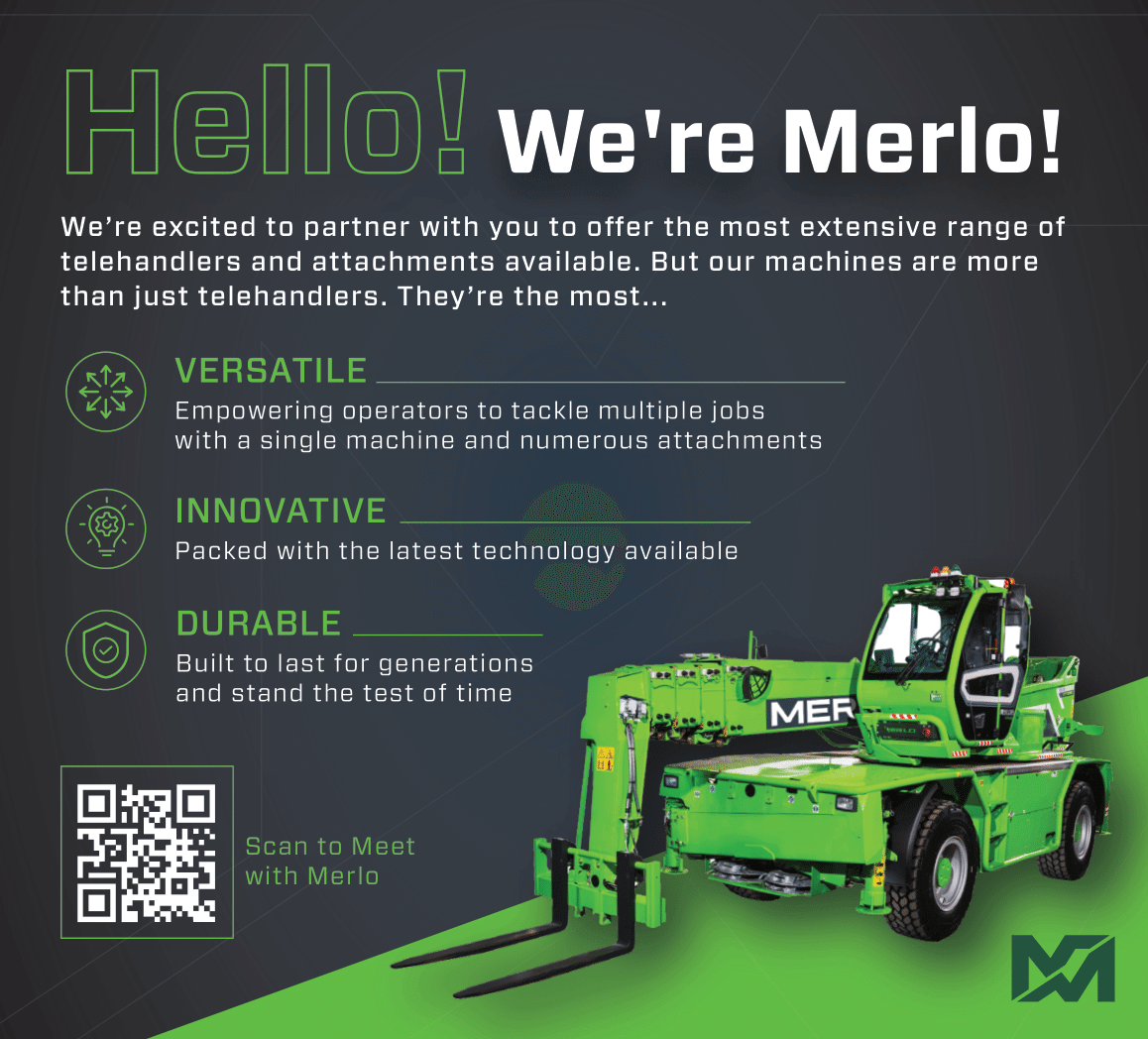
“Meet Merlo America” | Dealer Brochure
You’re probably familiar with the conference or trade show experience. You go, and it’s overwhelming. Maybe you speak to a few dozen people, three of whom are relevant, and then you go home and forget all about it. We are on a mission to break this cycle for our clients, which is why we worked to package the entire conversation into one sleek print piece Merlo could share with a prospective partner in the midst of a conference.
Takeaway: When your materials are visually engaging and informative, they build confidence and trust in your brand.
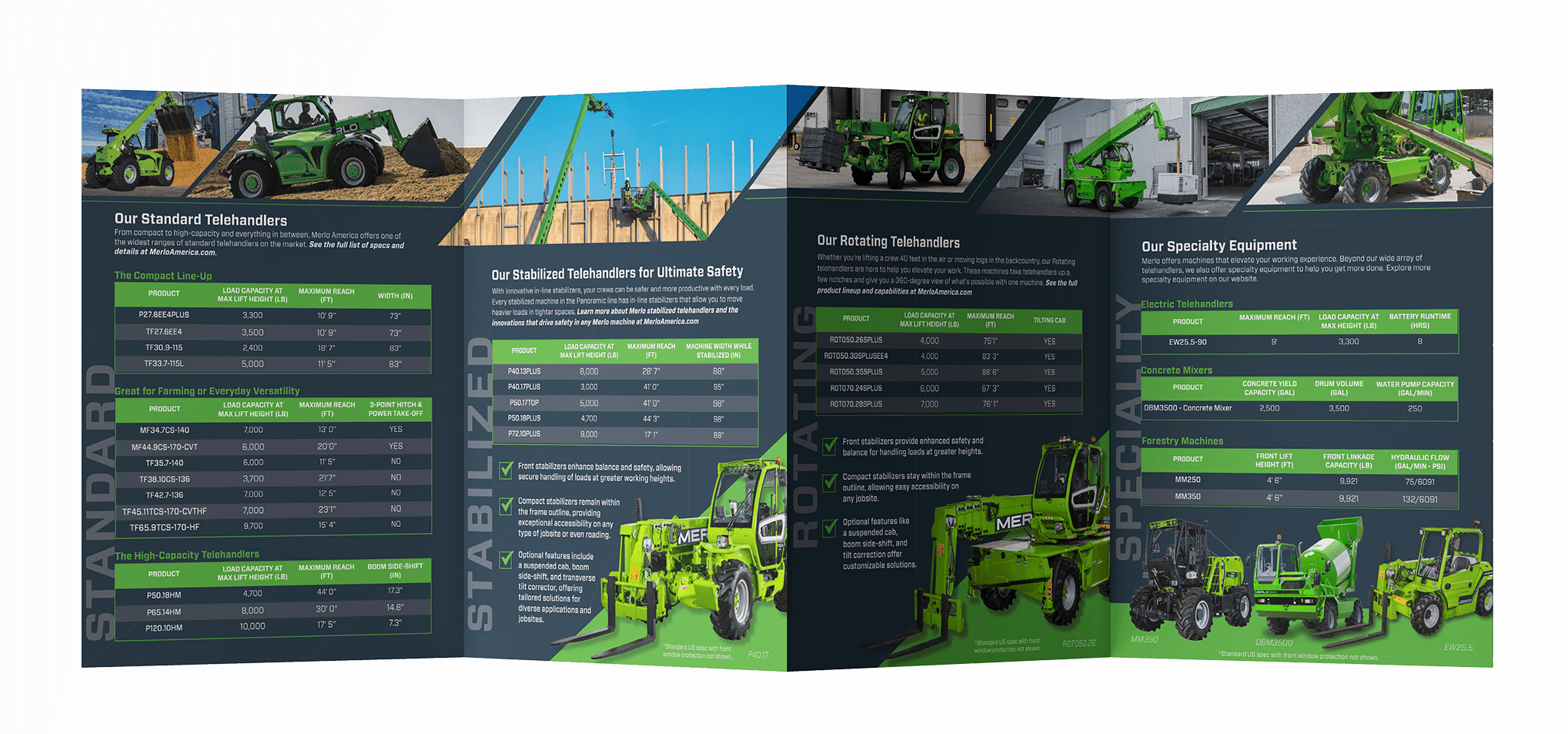
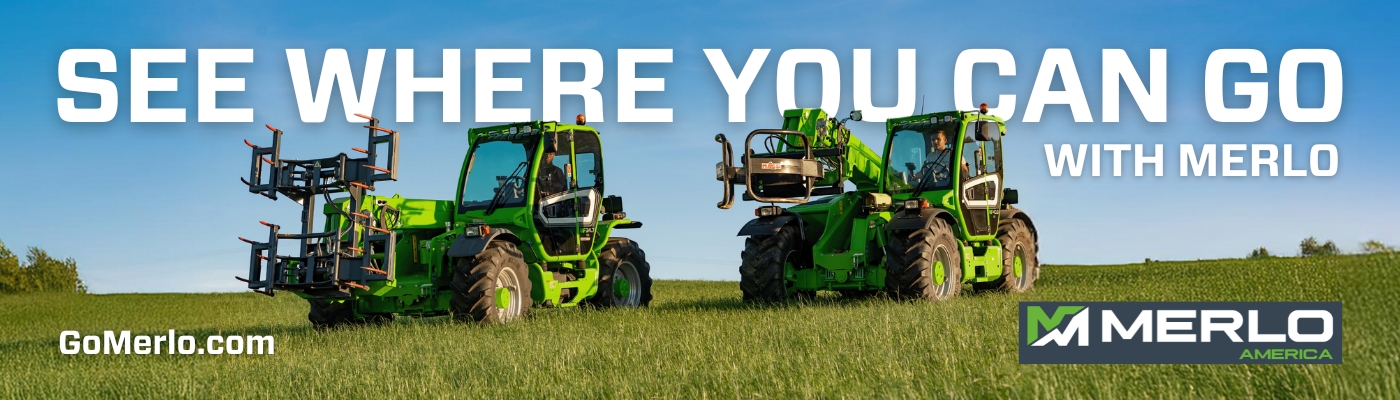
“See Where You Can Go with Merlo” | Advertising Campaign
From bold OOH displays to curated social media posts and high-impact print ads, the “See Where You Can Go with Merlo” campaign was all about catching the eye of dealers and conference goers at a pair of major trade shows. These pieces worked to meet the audience where they were while also reinforcing the key benefits of partnering with our client.
Takeaway: Successful campaigns aren’t limited to a single channel. An omnichannel marketing approach ensures your message reaches every corner of your audience's world.
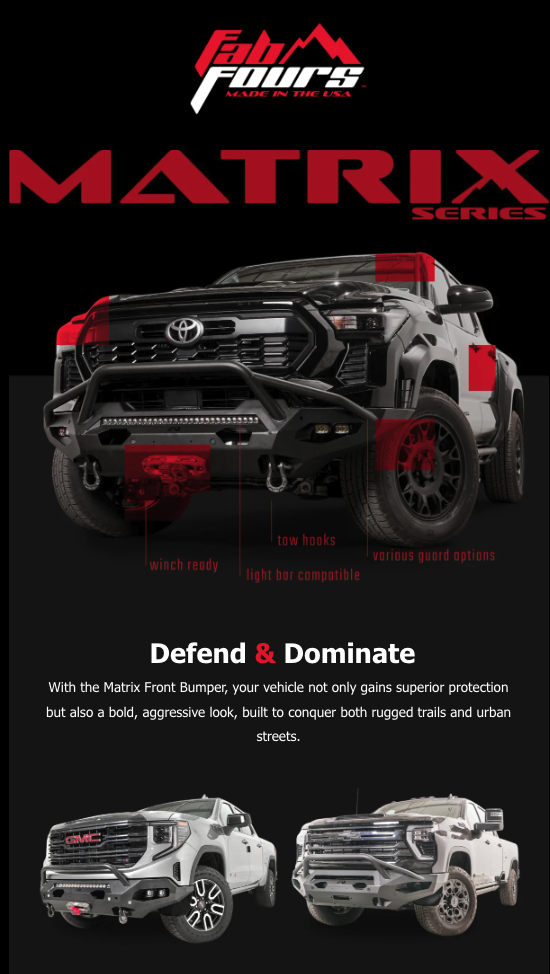
Fab Fours: Connecting through Email Campaigns
Not all of our favorite projects were massive brand campaigns like Merlo. Some were focused on key moments within a larger conversation with customers. Our partnership with Fab Fours gives us the opportunity to foster so many of these key moments and this campaign was a design favorite for our team.
Known for its rugged, adventurous image, Fab Fours leaned into its bold personality with an email campaign that was anything but ordinary. The primary goal of this campaign was to generate leads for its front bumper offer, but we knew their target audience wasn’t sitting around reading walls of text.
So, we leveraged custom layouts and striking graphics that mirrored the brand's powerful and adventurous spirit. After capturing the reader’s attention, the designs directed the reader toward focused copywriting to encourage conversion.
Finally, the email invites them to share their rugged and adventurous image with an offer that combines scarcity with value: a $150 rebate. This approach captivated its audience and delivered strong engagement metrics, highlighting the importance of effective design.
Takeaway: Visuals and copy are both important to drive engagement and communicate value. Focus on impactful uses of both to create meaningful results.

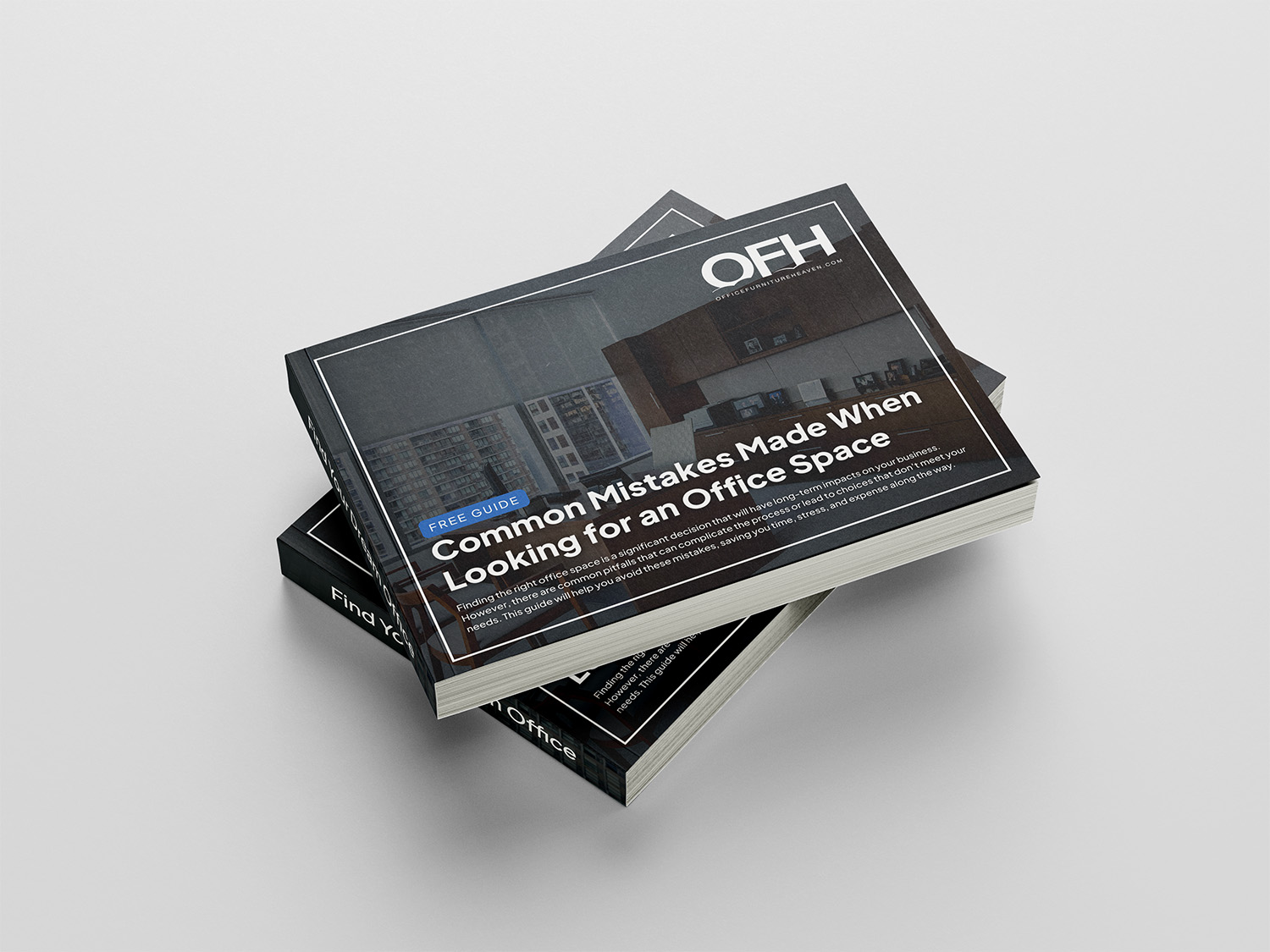
OFH: Building Authority with Gated Content
Office Furniture Heaven (OFH) was looking to pivot from furniture sales to office design and space consulting. To support this new service offering, we worked with the client to create a content piece that demonstrated their expertise in the service offering and showcased the beautiful work they had already done.
The guide explored “Common Mistakes Made When Looking for an Office Space,” which addressed customer pain points while delivering actionable insights in an engaging format. This combination of valuable content and thoughtful design proved to be a powerful lead-generation tool, driving significant downloads and conversions.
Takeaway: Educational content builds trust and positions your brand as an expert. When you’re looking to introduce a new product or service offering, using content to demonstrate authority is an important way to drive interest.
“More Than the Mountain” | Brand Launch Video
Pilot Mountain’s tourism video wasn’t just an ad—it was an invitation to step into something “more.” The video focused on beautiful shots of local mountain peaks, iconic town locations, and the people that make Pilot Mountain a unique place to live and visit.
“More Than the Mountain” spoke to the possibility and opportunity available to those who choose to step foot in Downtown Pilot Mountain after a day hike. We loved this video because it showed some of the best parts of a community we had come to know very well during our community branding project.
Takeaway: When launching a new brand, sometimes you need more than a logo and a tagline to share the story. Communities looking to strengthen their relationships with residents, businesses and tourists have been using video more frequently to share their stories.
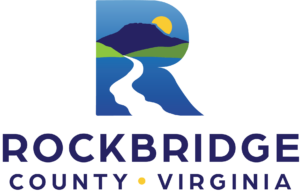
Rockbridge: Logo and Patch Design
Another aspect of a community branding project is taking a story – the story of families and local places – and creating a visual that demonstrates that story in a striking way. Rockbridge County chose HAVEN because it needed a brand to attract economic opportunities.
Through the project, we found that those opportunities already existed; it was our job to extract them in a way that was easy to communicate. The new county logo does this visually by incorporating the feel and spirit of the “Naturally Connected” branding that highlights just how many opportunities exist in the county.
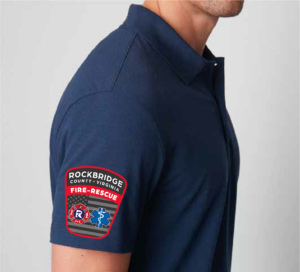
Rockbridge County Fire-Rescue’s 2024 rebranding was a design update that brought together several aspects: the iconic emergency services look, the county’s new branding, and the department’s dedication to the community.
The bold, clean visuals ensured the county branding stood out across all applications, from uniforms and vehicles to community outreach materials.
Takeaway: A great logo is more than just a series of colors and line strokes. It should tell the brand's story in a meaningful way. And sub-brands matter, too. This is why we put as much care and energy into the sub-brands to ensure consistency throughout an organization or community.
What Do These Campaigns Have in Common?
Each of these designs was not created out of thin air. They started with elements that already existed: Merlo America’s versatility as a team, the Fab Fours’ grand sense of adventure, Pilot Mountain’s sense of community and the existing opportunities found in Rockbridge County. A great campaign starts with a great foundation—you just need to work with a partner who can help you build on it.
Choosing HAVEN Creative means choosing a partner who can help you uncover the story just beneath the surface. If you’re ready to start growing, let’s make it happen. Contact us today for a free consultation, and let’s create something worth talking about!

New Year, New Goals: How to Align Your Brand Strategy for 2025 Success
Ah, the new year—when gym memberships spike, planners fly off the shelves, and brands dream big about their marketing goals. But let’s be real: setting goals is the easy part. Aligning your brand strategy with those goals? That’s where the magic (and hard work) happens.
Lucky for you, we’re here to help you turn those lofty ambitions into actionable plans. Whether you want to grow your organic website traffic by 50% or finally master TikTok dances (hey, we won’t judge), here’s how to align your marketing strategy for a wildly successful 2025.
Step 1: Get Crystal Clear on Your Goals
Before you start throwing marketing spaghetti at the wall, ask yourself: What do I actually want to achieve this year? Are you aiming for more web traffic? Better engagement? Global domination? (Okay, maybe scale it back a notch.)
Your goals should follow the SMART framework: Specific, Measurable, Achievable, Relevant, and Time-bound. Instead of saying, “We want more customers,” try: “We want to increase website conversions by 25% by Q3.” See the difference?
Pro Tip: Write down your top three marketing goals and keep them visible. Whether it’s on your desktop, whiteboard, or tattooed on your arm, seeing them daily keeps you focused.
Step 2: Match Tactics to Goals
Now that you’ve got your goals, it’s time to figure out how you’re going to achieve them. Spoiler alert: not every marketing tactic works for every goal.
- Want to grow organic website traffic? Focus on SEO. Optimize your site, create killer blog content, and sprinkle in those keywords.
- Hoping to boost engagement on social media? Invest in short-form video content, like TikToks and Instagram Reels, and show off your brand’s personality.
- Aiming for more email signups? Offer a lead magnet, like a free guide or exclusive discount, and make your sign-up process smoother than a fresh jar of Skippy.
Pro Tip: Pick the tactics that align directly with your goals and ditch anything that doesn’t move the needle.
Step 3: Know Your Audience (Like, Really Know Them)
If your 2025 strategy doesn’t revolve around your audience, you’re already off track. The better you understand your audience’s needs, preferences, and pain points, the better you can craft messaging that speaks directly to them.
Start by analyzing data from your website, social channels, and email campaigns. Look for patterns: What content gets the most clicks? Which posts spark the most engagement? Use this info to refine your strategy and ensure you’re giving the people what they want.
Pro Tip: Don’t forget to ask your audience for feedback! Surveys and polls are great for gaining insights—and they show your audience that you actually care about their opinions.
Step 4: Measure, Adjust, Repeat
No marketing strategy is perfect out of the gate (if it is, tell us your secrets!). The key to success is tracking your progress and being willing to pivot when something isn’t working.
Set up KPIs (Key Performance Indicators) for each goal. For example:
- Website traffic goal? Track unique visitors, bounce rate, and time on page.
- Social media engagement goal? Monitor likes, comments, shares, and follower growth.
Review your metrics regularly—monthly is a good starting point—and don’t be afraid to tweak your tactics. Remember, marketing is a marathon, not a sprint.
Pro Tip: Tools like Google Analytics and Hootsuite make tracking metrics easier than ever. Use them to your advantage!
Step 5: Don’t Forget the Human Touch
AI and automation are great for efficiency, but marketing is still about building relationships. Show your audience the human side of your brand with authentic messaging, engaging stories, and a sprinkle of humor (we recommend the jester tone, obviously).
Respond to comments, answer DMs, and make your audience feel seen. Building trust and loyalty takes time, but it’s worth every second.
Pro Tip: A little personality goes a long way. Don’t be afraid to let your brand’s quirks shine!
Step 6: Bring in the Experts
Feeling overwhelmed? You’re not alone. Aligning your goals with your marketing strategy is no small task, but you don’t have to go it alone.
At HAVEN, we specialize in turning big goals into actionable plans. Whether you need help refining your strategy, choosing the right tactics, or simply figuring out where to start, our Mavens are here to guide you every step of the way.
Ready to Crush Your 2025 Goals?
Let’s make this the year your brand strategy shine. Whether you’re looking to drive traffic, boost engagement, or skyrocket conversions, we’ve got the expertise and tools to help you get there.
Contact a Maven Today and let’s talk strategy. We will help you align your goals with your marketing plan and set you up for success in 2025.
2025 Marketing Trends: Everything You Need to Know (and Then Some)
Grab your coffee, marketing mavens, because 2025 is coming in hot with trends that will change the game. We’ve combed through the HAVEN 2025 Marketing Report to bring you the highlights—but trust us, you’ll want to download the full thing to get the juicy details.
Marketing is evolving at the speed of light, and it’s crucial to stay ahead of the curve. Here’s your insider scoop on what’s shaping the marketing world in 2025, plus actionable tips to start slaying your strategy today.
1. AI-Powered Creativity: The Robots Are Here (and They’re Fabulous)
Artificial intelligence isn’t just for sci-fi movies anymore. From generating content to analyzing audience behavior, AI tools are becoming a marketer’s new BFF. But don’t worry, we’re still the masterminds behind the creative magic—AI just helps us get there faster.
AI’s ability to personalize campaigns, create content, and even predict customer preferences is a game-changer. Imagine cutting your brainstorming time in half or automating repetitive tasks so you can focus on big-picture strategy.
Your 2025 Move:
Start exploring AI tools like ChatGPT or design assistants like Canva’s AI features. Begin with small tasks—like generating ideas or streamlining your email campaigns—and scale as you grow more confident.
2. Personalized Marketing: Say Goodbye to Generic Spam
Nobody wants to feel like they’re just another name in a giant email list. In 2025, it’s all about personalization—creating tailored experiences that make your audience say, “Wow, they really get me!”
From dynamic email content to personalized ad targeting, brands that go the extra mile to understand their audience will build stronger relationships and higher engagement rates.
Your 2025 Move:
Use CRM software to track customer preferences and behaviors. Segment your audience into specific groups and craft messaging that speaks directly to their needs. Test personalized landing pages and watch those conversions soar!
3. Sustainability Sells: Why Your Brand Needs to Go Green
Consumers are paying more attention to sustainability, and brands need to catch up. Whether it’s eco-friendly packaging, carbon-neutral initiatives, or aligning with social causes, showing you care about the planet isn’t just trendy—it’s essential.
Authenticity is key. Customers can spot a fake faster than you can say “greenwashing,” so make sure your efforts are genuine and impactful.
Your 2025 Move:
Start by conducting a sustainability audit of your business practices. Highlight these efforts in your marketing, whether it’s a social post about your eco-friendly packaging or a campaign about your latest community impact initiative.
4. Short-Form Video Domination: Blink and You’ll Miss It
If you thought short-form video was big in 2024, buckle up for 2025. Platforms like TikTok and Instagram Reels are still dominating, and bite-sized, scroll-stopping content is king.
The best part? Short-form video lets you show your brand’s personality in just a few seconds. Whether it’s a behind-the-scenes clip, a quick tip, or a funny moment, these videos are gold for engagement.
Your 2025 Move:
Invest in creating snackable video content. Start small—think tutorials, FAQs, or fun team moments—and use analytics to see what resonates most with your audience. Consistency is key, so post regularly to build momentum.
5. Community-Led Growth: Bring People Together
Brands that build strong communities win in the long run. Community-led growth is all about creating spaces for your audience to connect with each other—and your brand. Think online forums, social media groups, or exclusive memberships.
Why does this work? People crave connection, and when your brand provides it, you’re fostering loyalty and advocacy.
Your 2025 Move:
Start fostering conversations on your social channels. Ask questions, host live Q&A sessions, or create exclusive content for your most loyal followers. Want to take it a step further? Launch a private Facebook group or Slack channel for your community.
6. Data Privacy: Trust Is the New Currency
With privacy laws tightening up, transparency about how you handle data is critical. Customers want to know their information is safe, and brands that deliver on this promise will gain trust and loyalty.
From GDPR to newer regulations, compliance isn’t optional—it’s necessary. Plus, being transparent about your data practices builds credibility with your audience.
Your 2025 Move:
Review your data collection and storage policies to ensure compliance with the latest regulations. Be upfront with your audience about how their data is used, and make opting in as simple as possible. Bonus: Create a short video or infographic explaining your privacy practices—it’s a great way to show transparency.
7. Conversational Marketing: Chatbots with Personality
Conversational marketing, like chatbots and direct messaging, is taking customer engagement to the next level. It’s not just about answering questions—it’s about creating experiences that feel personal and real.
AI-powered chatbots can handle routine inquiries, leaving your team free to tackle more complex customer needs. Add a dash of personality to your bot, and you’ve got a powerful tool for engagement.
Your 2025 Move:
Set up a chatbot on your website or social channels to provide instant responses to FAQs. Make sure it reflects your brand voice—fun, friendly, and helpful wins the day.
8. Cross-Channel Integration: Consistency Is Key
Your audience is everywhere—so your brand needs to be too. Cross-channel integration ensures your message stays consistent across all platforms, whether it’s a social media ad, email campaign, or website content.
Why does this matter? A seamless experience builds trust and reinforces your brand identity.
Your 2025 Move:
Audit your current marketing channels to ensure your branding and messaging are aligned. Use tools like Hootsuite or HubSpot to manage and track campaigns across multiple platforms.
Ready to Slay 2025?
These trends are just the tip of the marketing iceberg. To dive deeper into what’s next, download the full 2025 HAVEN Marketing Report. It’s packed with actionable insights, expert tips, and a little sass (because, let’s face it, boring reports aren’t our thing).